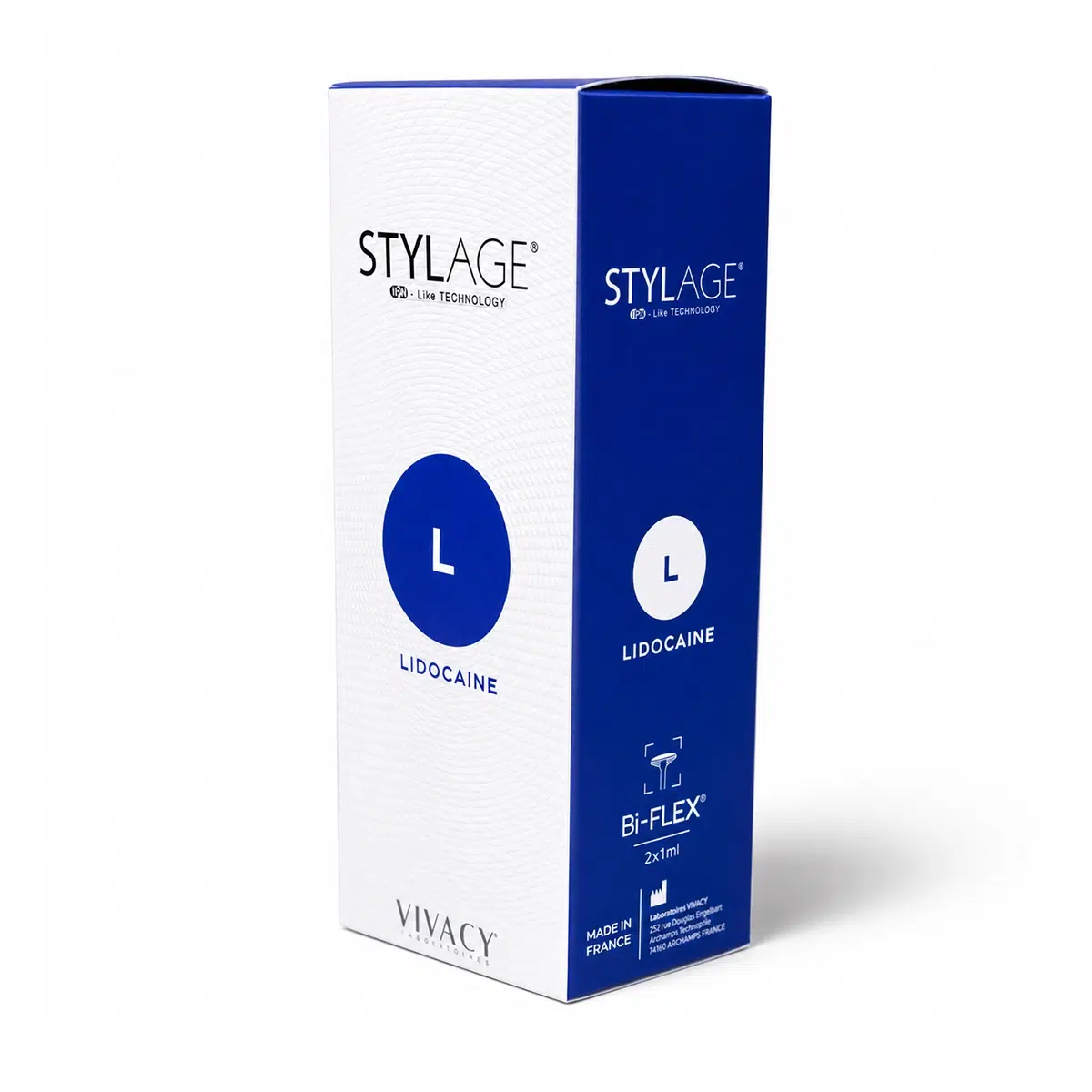
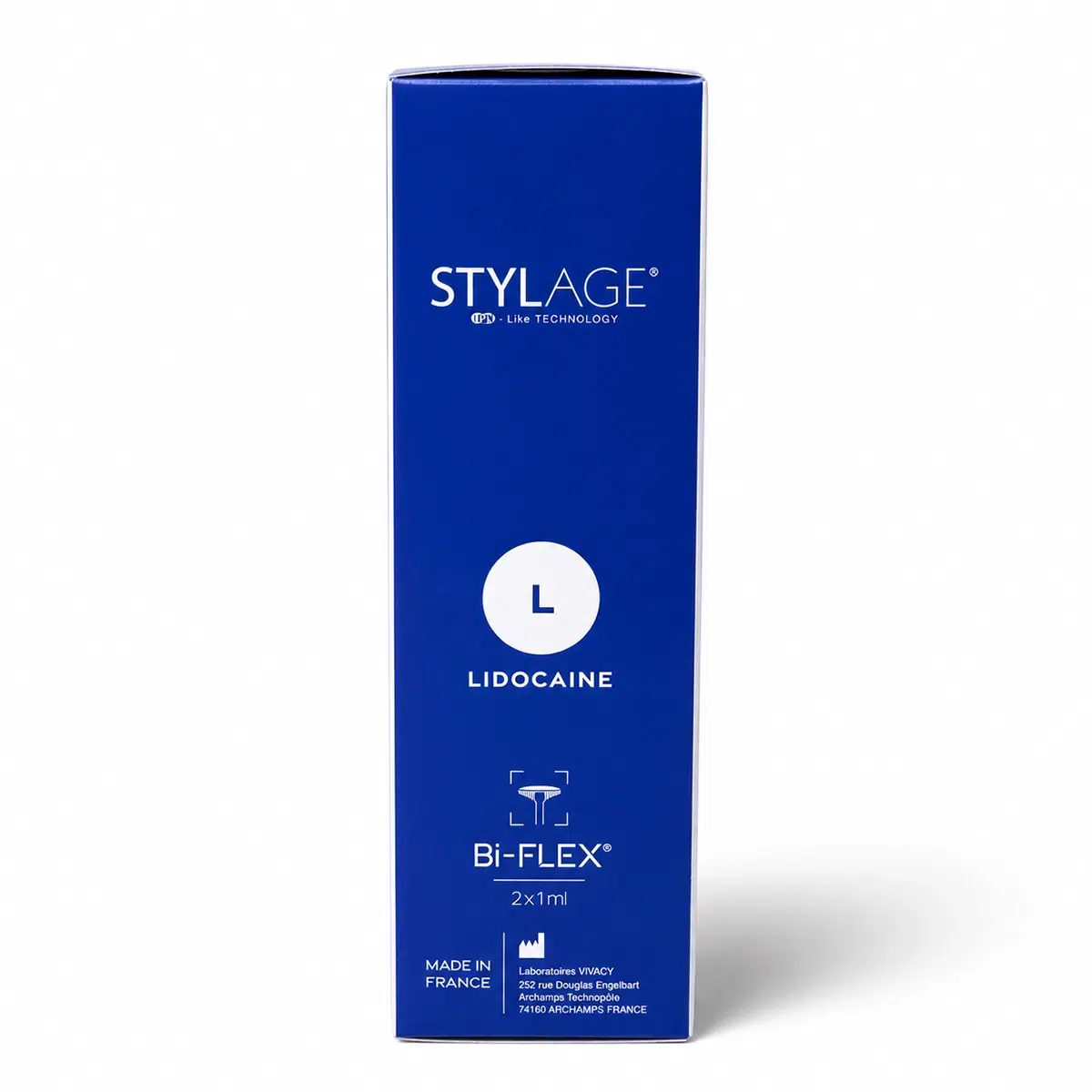
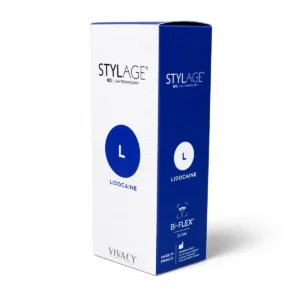
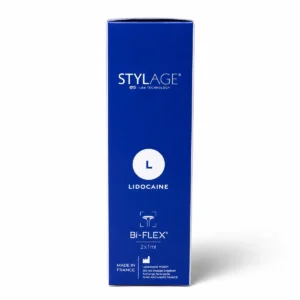
STYLAGE® L BI-FLEX® with Lidocaine — FDA-Reviewed Hyaluronic Acid Filler for Deep Wrinkles & Facial Volume Loss
Product Specifications
| Field | Details |
| Drug Class | Injectable hyaluronic acid dermal filler (cross-linked, BI-FLEX® technology) |
| Active Ingredients | Hyaluronic acid (cross-linked) 24mg/g; Mannitol 9mg/mL; Lidocaine 3mg/mL |
| Manufacturer | Laboratories VIVACY |
| Brand | STYLAGE® |
| Country of Origin | France |
| Strength | 24mg/g HA; 9mg/mL Mannitol; 3mg/mL Lidocaine |
| Dosage Form | Injectable gel — 2 × 1mL prefilled syringes + 4 × 30G ½ needles |
| Regulatory Status | CE-marked (EU); not currently approved by the US FDA |
Mechanism of Action
Cross-linked hyaluronic acid is the structural foundation of STYLAGE® L BI-FLEX® with Lidocaine. Once delivered into the dermis, the HA matrix integrates with surrounding tissue, binds water, and restores lost volume. As a result, it smoothes deep wrinkles at the injection site and re-establishes facial contour.
The degree of cross-linking is engineered to balance longevity and tissue compatibility, making the product well-suited for treatment areas with significant volume loss.
IPN-Like Technology™
The defining feature of STYLAGE® L BI-FLEX® is its IPN-Like Technology™, an interpenetrating polymer network comprising two interlocked HA chains, rather than a conventional single-network gel. This architecture confers superior cohesivity, enhanced elasticity, and improved resistance to mechanical deformation under the dynamic forces of facial movement.
Compared to standard cross-linked fillers, the dual-network structure better preserves three-dimensional form over time, contributing to a more consistent and enduring correction.
Mannitol (9mg/mL)
Mannitol is incorporated into the gel matrix as a free radical scavenger. Reactive oxygen species are a principal driver of accelerated HA degradation in vivo; mannitol’s antioxidant activity inhibits this oxidative breakdown, extending the functional lifespan of the implant.
This is directly relevant to the clinical question of how long STYLAGE® filler lasts: results typically range from 12 to 18 months, though the duration is influenced by factors such as skin type, treatment area, injection depth, and patient lifestyle.
Lidocaine (3mg/mL)
Lidocaine is an amide-type local anesthetic co-formulated within the gel matrix. During lidocaine administration, the anesthetic diffuses into adjacent tissue at the injection site, attenuating procedural discomfort without requiring a separate topical or nerve block preparation.
This integration streamlines treatment and supports patient tolerability without measurably altering the filler’s rheological behavior. The maximum safe dose per session must be observed, as systemic absorption remains possible regardless of the delivery route.
Reversibility
STYLAGE® L BI-FLEX® with Lidocaine is fully reversible. Clinical reversal may be warranted in cases of overcorrection, vascular compromise, or patient request. Hyaluronidase injection will enzymatically hydrolyze the cross-linked HA, safely dissolving the implant.
About STYLAGE® L BI-FLEX® with Lidocaine
STYLAGE® L BI-FLEX® with Lidocaine is CE-marked and authorized for professional aesthetic use across the European Union. The BI-FLEX® designation refers to a precisely calibrated rheological profile — balancing viscosity, elasticity, and injectability — engineered for controlled, smooth delivery and natural-looking correction at the target site.
Practitioners evaluating whether STYLAGE® is a good filler will find that the combination of IPN-Like Technology™, mannitol-enhanced longevity, and integrated lidocaine addresses three of the most clinically relevant performance parameters: structural durability, product lifespan, and patient comfort. Published tolerability data for the STYLAGE® range support a favorable safety profile in patients treated by qualified practitioners following the indicated conditions of use.
Is STYLAGE® L BI-FLEX® with Lidocaine FDA-Approved?
The product is CE-marked for professional aesthetic use in the EU and is not currently approved by the US FDA. Practitioners operating outside the EU should independently verify local regulatory clearance before ordering or administering this product. Regulatory information on this page is current as of 2026.
Practitioners wishing to buy STYLAGE® or buy dermal fillers through an authorized channel should confirm product authenticity and documentation with their chosen distributor. Contact Medica Depot’s support representatives for sourcing information and documentation support.
Indications & Clinical Use of STYLAGE® L BI-FLEX® with Lidocaine Injection
STYLAGE® L BI-FLEX® with Lidocaine injection is indicated for two primary clinical applications in aesthetic medicine: deep wrinkle correction and facial volume restoration. It is formulated for placement at the mid-to-deep dermis or subcutaneous plane, providing the lift capacity needed to address areas of significant structural volume loss.
- Deep Wrinkle Correction: Primary treatment areas include nasolabial folds and marionette lines, perioral rhytids, and glabellar lines. These are sites characterized by deep static rhytids in which superficial filler placement provides insufficient volumetric support. The cohesive gel matrix delivers the structural lift required at these depths.
- Facial Volume Restoration: STYLAGE® L BI-FLEX® is also indicated for volumizing the cheeks, chin, and jawline. It can contour regions where progressive, age-related volume loss produces significant aesthetic changes. Subcutaneous placement at these sites enables broader tissue expansion and structural repositioning.
Patient Selection and Pre-Treatment Assessment
Before injection, practitioners should evaluate the patient’s skin condition, including skin type, tissue thickness, degree of laxity, and overall facial anatomy. This assessment confirms suitability and informs appropriate injection depth and volume.
Practitioners must maintain aseptic technique throughout and screen for all relevant contraindications before proceeding. Intravascular injection must be avoided in all treatment areas.
STYLAGE® L BI-FLEX® with Lidocaine injection is intended exclusively for administration by licensed practitioners in aesthetic medicine. It is not suitable for self-administration under any circumstances.
Administration & Injection Guidelines
Following treatment, practitioners should provide patients with clinically appropriate written aftercare instructions and schedule a follow-up assessment.
To ensure optimal recovery and minimize complications, patients should be advised to follow these guidelines:
- Sun Protection: Avoid sun exposure until all residual swelling and redness have completely resolved.
- Activity Restrictions: Refrain from strenuous physical activity, alcohol consumption, and facial heat treatments during the immediate post-treatment period.
- Injection Site Care: Expect any bruising at the injection site to be temporary and to resolve within a few days under normal recovery conditions.
Side Effects & Safety Profile
Common Adverse Events
The most frequently reported side effects following STYLAGE® L BI-FLEX® with Lidocaine administration are localized injection-site reactions:
- Bruising at the injection site
- Redness
- Swelling
- Tenderness
These are typically transient and resolve within a few days without the need for intervention.
Serious Adverse Events (Rare)
Severe events are uncommon but include:
- Vascular occlusion
- Skin necrosis
- Visual disturbance
Of these, vascular occlusion represents the most time-sensitive complication associated with injectable dermal fillers; practitioners must be fully trained in prompt recognition and emergency management, including the immediate availability of hyaluronidase for reversal where indicated.
Lidocaine Considerations
As an amide-type anesthetic, lidocaine carries a risk of systemic reactions in sensitive or hypersensitive patients. Prior to treatment, practitioners must confirm the absence of known hypersensitivity to lidocaine, amide-type anesthetics, or hyaluronic acid. The maximum dose per session must be observed to minimize systemic risk.
Complete Safety Reference
This section is a clinical summary only. Practitioners must consult the full Instructions for Use (IFU) provided with the product for the complete list of contraindications, warnings, precautions, and adverse event management protocols before administering STYLAGE® L BI-FLEX® with Lidocaine.
Legal & Regulatory Status
STYLAGE® L BI-FLEX® with Lidocaine is manufactured by Laboratories VIVACY in France and carries CE marking, authorizing its use as a professional aesthetic injectable across the European Union. The product is not currently approved by the US FDA. Practitioners in the United States and other non-EU regions must independently verify whether STYLAGE® L BI-FLEX® with Lidocaine holds applicable regulatory clearance in their jurisdiction prior to ordering or administration.
This product is restricted to licensed medical professionals and registered aesthetic clinics. It is not available for general consumer purchase or self-administration.
When buying online, practitioners should source exclusively from verified, authorized distributors who can provide documentation of product authenticity and supply chain compliance. Regulatory information on this page is current as of 2026 and is subject to change; practitioners should verify current local regulatory status before ordering or administering this product.
Practitioners wishing to buy STYLAGE® or other similar products through an authorized channel should confirm product authenticity and documentation with their chosen distributor. For sourcing guidance and more regulatory information, contact Medica Depot’s support representatives.
Citations
- Micheels P, Sarazin D, Tran C, Salomon D. Effect of different crosslinking technologies on hyaluronic acid behavior: A visual and microscopic study. ResearchGate. Published online May 1, 2016. https://www.researchgate.net/publication/302969213_Effect_of_Different_Crosslinking_Technologies_on_Hyaluronic_Acid_Behavior_A_Visual_and_Microscopic_Study_of_Seven_Hyaluronic_Acid_Gels
- Tran C, Carraux P, Micheels P, Kaya G, Salomon D. In vivo bio-integration of three hyaluronic acid fillers in human skin: A histological study. 2013;228(1):47–54. doi:10.1159/000354384
- Rzany B, Becker-Wegerich P, Bachmann F, Erdmann R, Wollina U. Hyaluronidase in the correction of hyaluronic acid-based fillers: a review and a recommendation for use. Journal of Cosmetic Dermatology. 2009;8(4):317–323. doi:10.1111/j.1473-2165.2009.00462.x
The contents of this page are meant for licensed medical professionals. They serve informational purposes only and are not to be taken as medical advice.
Related products